Where we are
So far, the current focus on solar power has mostly been with silicon photovoltaics, those big blue panels you see on the side of the road or on some people's homes. There are, however, a number of other types of solar power that are beginning to get a little bit more attention.
The energy payback time for CSP plants is approximately five months
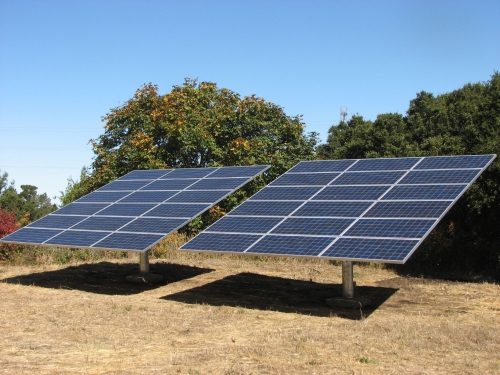
Photovoltaic panel arrays. These have been the focus of solar energy up until now, and while they have their place, they have some limitations and should not be the major focus of solar energy. That is a place that should be reserved for small solar thermal systems.
Credit: Everystockphoto.com
Solar energy has been growing quite a bit in recent years, increasing capacity
51% in 2007. Even with these increases though, solar was around
1% of just the non-hydro renewable electricity globally last year. In the US, it is
less than 1% of total renewable energy. These numbers do, however, exclude solar thermal installations that produce heat as opposed to electricity.
Life-cycle Energy Payback
Life-cycle energy paybacks look not at the lifetime monetary costs of a solar system, but instead the lifetime energy costs of the system. The Life-cycle energy payback is the amount of time it takes a solar system to produce as much energy as it took to produce it and keep it running. In 2000, this was estimated to be
8 to 11 years, but more recently, crystalline silicon PV systems have been estimated to have life-cycle energy paybacks closer to
1.5 to 3.5 years. Thin film technologies in Southern Europe are as low as 1-1.5 years. Given the fact that these systems have lifetimes of at least 30 years, the EROEI (Energy Return On Energy Investment), is in the range of 10 to 30, depending on the material used, how the system is constructed, and the geographic location of the system. The EROEI is calculated by dividing the lifetime by the energy payback period and represents the number of times the system will pay for itself with regards to energy production, meaning higher is better.
This number gets even better when looking at CSP technologies. The energy payback time for CSP plants is approximately
five months whereas the lifespan is 25 to 30 years, making an EROEI of 60 to 72. The energy payback of a home-scale solar thermal system can be calculated on the How We Get There page for your own area.
Life-cycle Financial Payback
The financial paybacks of these systems are very dependent on the specific technology used and where they are located. Currently, CSP and both kinds of PVs are more expensive than conventional energy, but have been showing regular price decreases. Home-scale solar thermal systems often payback rather quickly, however. You can check out how quickly a system would pay off if placed on your home on the
How We Get There section.
World Watch Institute - Solar 2007 ReviewReview of the increases in the solar market in 2007, written in May 2008.
Click now to view EIA - International Energy StatsDatabase of global energy statistics.
Click now to view EIA - US renewable fuel dataData on renewable fuels used within the US.
Click now to view BNet - Solar EnergyLook at the financial and energy costs of multiple solar power options.
Click now to view

 Get the Facts
 Do Your Part
 Transportation
 Making Energy
 Using Energy
 Basic Needs
 Nature
 Climate Change


 Support SixLinks