How we get there
If you own your home, you need to be working to decrease the amount of energy used to heat and cool your home. Even if you rent, there are still things you can be doing to reduce the energy needed to keep your house at a comfortable temperature. The first thing to think about is what you want your house to be compared to what the outside is likely to be over the course of the year. Understanding that you want your home at 65 degrees and being aware of the temperature throughout the course of the day is very helpful. If it is 70 outside, shut everything off and open up some windows and doors. Also be aware of the fact that if it is 20 outside, you will need to seal your house up very tight to prevent warm air from leaking out. Taking outside temperature into account is also important for seasonally adjusting your thermostat. Keeping your house at 75 during the summer may be comfortable, but is going to require a lot of energy to maintain in the winter.
No one else is going to make your house more efficient for you
There are two main ways of reducing your heating and cooling load. The first is to better seal your house so that the temperature stays constant with less energy from heating and cooling systems. If you want to make a large impact on your CO
2 emissions, and your budget, forget the hybrid and break out the caulking gun. Sealing up cracks that allow draughts into the house is the first and most important thing you can do to better seal your home. Go around, especially on a windy day, and find where air from the outside is coming into your home. This is a cheap and easy way to reduce heating and cooling costs. The second thing you can do to better seal your home is to replace windows and doors with more energy efficient versions and to add energy-saving shades to your windows that help keep your nicely treated air inside. You can check out the Do Things section to find step by step guides on how to do this. The last thing you can do is to add more insulation to your home. If you are doing anything to an exterior wall, replace the insulation with material that will keep heat and cold out of your house. You can also improve the insulation in the attic and crawl spaces to reduce your heating and cooling load.
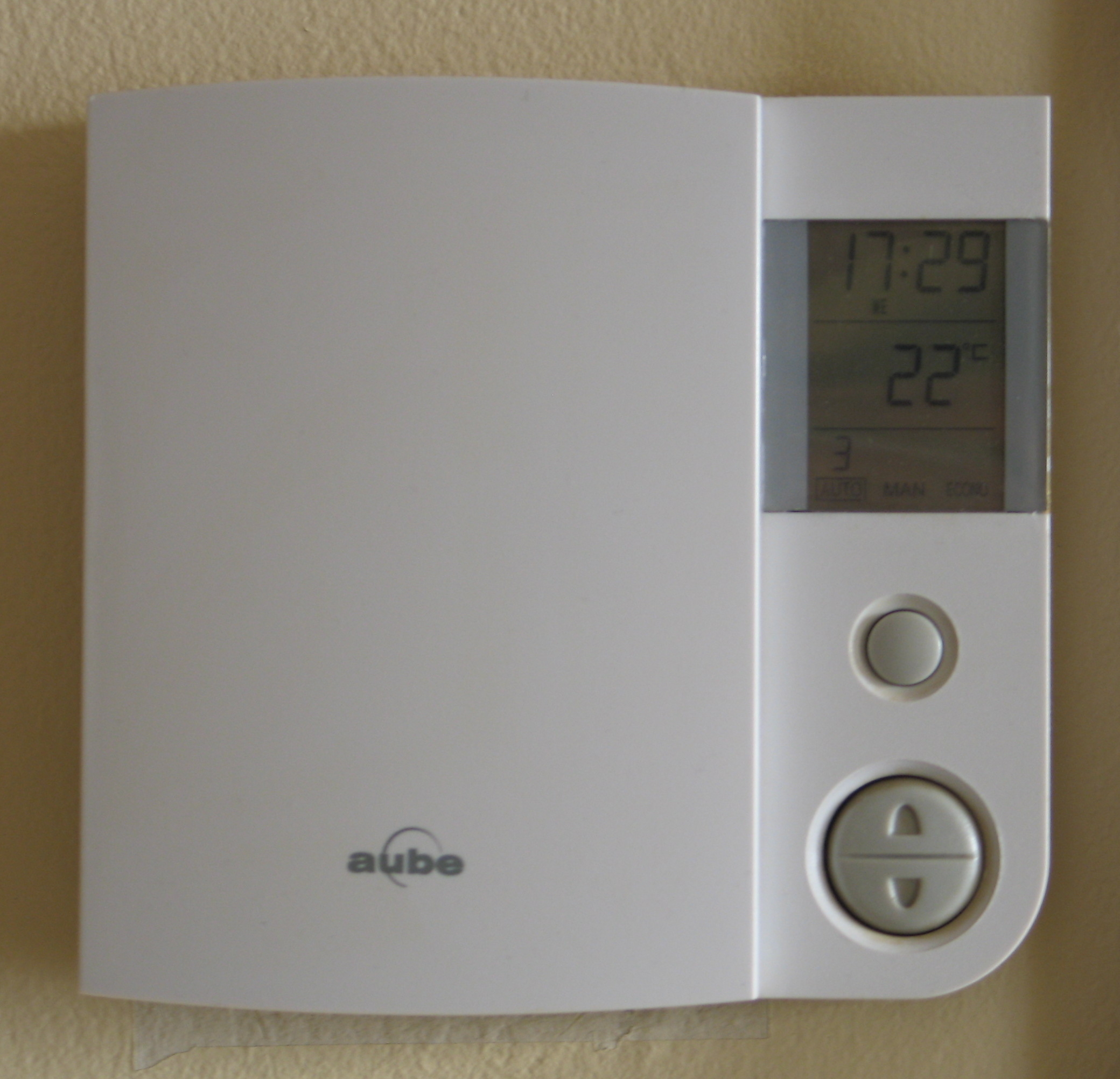
Programmable thermostats allow you to set different temperatures for your house at different times of the day.
Credit: Wikimedia Commons
The second way to save energy and money by reducing heating and cooling loads is by changing the amount of time the heating and cooling systems are running. The easiest way to do this is to turn up or down your thermostat, depending on the weather outside. If it is cold outside, turn down the thermostat to make your house work a little bit less. If it is hot outside, turn up the thermostat so that you don't ask the house to cool down quite as much. The next step in this is to have a programmable thermostat that can turn down the heat while you are sleeping and turn off the air conditioning when you are at work. You likely are in your awake in your house for only a small portion of the day, and there is no reason to be spending energy to heat or cool the house when you aren't able to notice it anyway. The final step is to install an automation system that turns things on and off based on your desired temperature, the time, the outside temperature, and the occupancy of the home. These systems are a bit expensive, but are becoming more reasonable and can make your house much more efficient for you without much sustained effort.
This is one of those things that only you can do for yourself. No one else is going to make your house more efficient for you. Fortunately, these projects tend to be rather simple and will
save you money on your heating and cooling bills. As a rough estimate, every degree you turn down the thermostat in the winter will save
3% of your energy costs. You can also, if you haven't installed a
solar hot water heater, turn down your hot water setting by
10 degrees to save 3-5% of your energy costs.
PSEG - Turn Down ThermostatPSEG Press Release encouraging users to turn down their thermostats to save money.
Click now to view EnergySavers.gov - Hot Water HeaterDOE energy saving suggestions on reducing the energy consumption of your hot water heater.
Click now to view
 Tomo Says:
Tummy rubs are the best thing ever. Seriously.

 Get the Facts
 Do Your Part
 Transportation
 Making Energy
 Using Energy
 Basic Needs
 Nature
 Climate Change


 Support SixLinks