Why it's important
Money is on the list of basic needs, because food, water, and shelter aren't free. There are billions in the world that do not have access to even the most basic of financial institutions, limiting how these people can interact with the rest of the world. Those in developing economies need the same financial services you do, but they just use informal services that are not as reliable. For example, people save by investing in assets such as gold, jewelry, domestic animals, building materials, and other things that can be easily exchanged for cash. Crops can be saved, money can be buried or hidden, they can use informal savings groups, which contribute a small amount of money on a certain time basis and rotate the rewarding of the pot or may allow borrowing from the pot.
Microfinance helps individuals meet their basic needs and protect against risks
There are limitations, however; the assets are not always easily divisible when a small amount of money is needed, they may be subject to fluctuations in commodity prices, destruction by natural forces or sabotage. There is also the risk of thieving/fraud, especially in the case of savings groups. As an alternative, neighbors, family, or local cash collectors can be used, but they are risky and may not be widely available options, plus
they are also subject to possibly thieving and fraud.
In addition to lacking banks, many people in the world lack access to lines of credit and insurance. Rather than going to the bank for a loan, many poor tend to borrow money from local moneylenders, whose interest rates can be very high. According to an analysis of 28 studies from 14 countries,
76% of moneylender rates exceed 10% a month, including 22% that exceed 100% a month. A 100% a month interest rate means that if I give you $1000, at the end of the month you owe me $2000, and at the end of 3 months, you owe me $4000. There is also no insurance in many places, so even if you did have the money to invest in something without taking out a loan, you may be hesitant to do so in case something bad happens and you need the money later and don't want to be subject to ridiculously high interest rates.
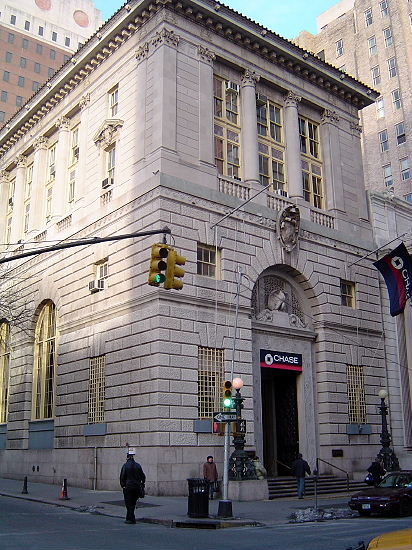
How often do you visit the bank? Imagine trying to get through your life if you had no place to keep money or to take out loans. Imagine living in a cash or asset-only world.
Credit: Wikimedia Commons
It is an accepted idea that the development of a nation's economy is very dependent on the development of a healthy national financial system, which has often focused on developing a commercial banking sector. While this is important, also important is the development of a banking sector
capable of providing financial services for the majority of a nation's population.
Proven Effects of Microfinance:
Studies have found that microfinance has a number of
beneficial effects on the public in general and women specifically.
- Microfinance helps individuals meet their basic needs and protect against risks.
- Microfinance helps low-income households improve household economic welfare and business stability or growth.
- Microfinance can smooth consumption levels and significantly reduce the need to sell assets to meet basic needs. It helps people cope with expenses resulting from death, illness, or loss of assets.
- Credit allows the poor access to more economic opportunities by allowing for the planning and expanding of business activities. Many studies have shown that those in microcredit programs tend to become more wealthy than those without, and they sometimes even move out of poverty.
- Microfinance allows poor households to move from thinking about every day survival to planning for the future, allowing them to invest in their children's educations and to invest earnings into better nutrition and living conditions, as well as health care.
- Studies have shown that those with access to microfinance programs were able to improve their individual and household well being much more than those who did not have access to those financial services.
- In Bangladesh, Bangladesh Rural Advancement Comittee (BRAC) clients increased their household expenditures by 28% and assets by 112%. The incomes of Grameen Bank members were 43% higher than the incomes of those villagers not in the program.
- In El Salvador, the weekly income of FINCA clients increased by an average of 145%.
- In India, half of the villagers participating in the SHARE program graduated out of poverty.
- In Ghana, 80% of Freedom from Hunger had secondary income sources, compared to 50% for non-clients
- In Lombok, Indonesia, the average income of Bank Yakyat Indonesia (BRI) borrowers increased by 11% and 90% of households graduated out of poverty.
- In Vietnam, Save the Children clients reduced food deficits from three months to one month.
- Microfinance typically targets poor women to help empower them, promoting gender-equity and in proving household well-being
- Many studies have shown how making women responsible for loans, savings, accounts, and insurance coverage programs improves the status of women in the family and the community, causing them to become more confident and assertive. They have also seen increases in mobility and the ability to negotiate publicly. Women are more likely to own assets, including land and housing, and play a stronger role in decision making.
- Microfinance programs have some influence in lowering rates of violence against women.
 Tomo Says:
Becoming a
supporting member is easy. Just donate any amount to SixLinks monthly. Really, that's it, and that's how we keep running!

 Get the Facts
 Do Your Part
 Transportation
 Making Energy
 Using Energy
 Basic Needs
 Nature
 Climate Change


 Support SixLinks