Where we've been
Global food insecurity has been an issue for a very, very long time, but has begun to receive a lot of attention in the last few decades. The biggest thing that has been done to try to address the issue of world hunger has been donations of either money or surplus food to areas that don't have enough of it. This process still occurs today. There was, and still to some extent is, a major attempt to get the poor of the world better crops along with the education needed on how to grow these crops. This has, somewhat confusingly, been called the Green Revolution (not to be confused with the attempt to live more sustainably, use clean energy, or anything else this website talks about).
The success of the Green Revolution depends on who you ask about it
The success of the Green Revolution depends on who you ask about it. There has been a lot of funding into creating more productive plants and attempts to distribute them and educate locals on how to plant and care for them. On the other hand, it has contributed to a recent trend against using a wide variety of local, diverse, naturally evolving crop varieties.
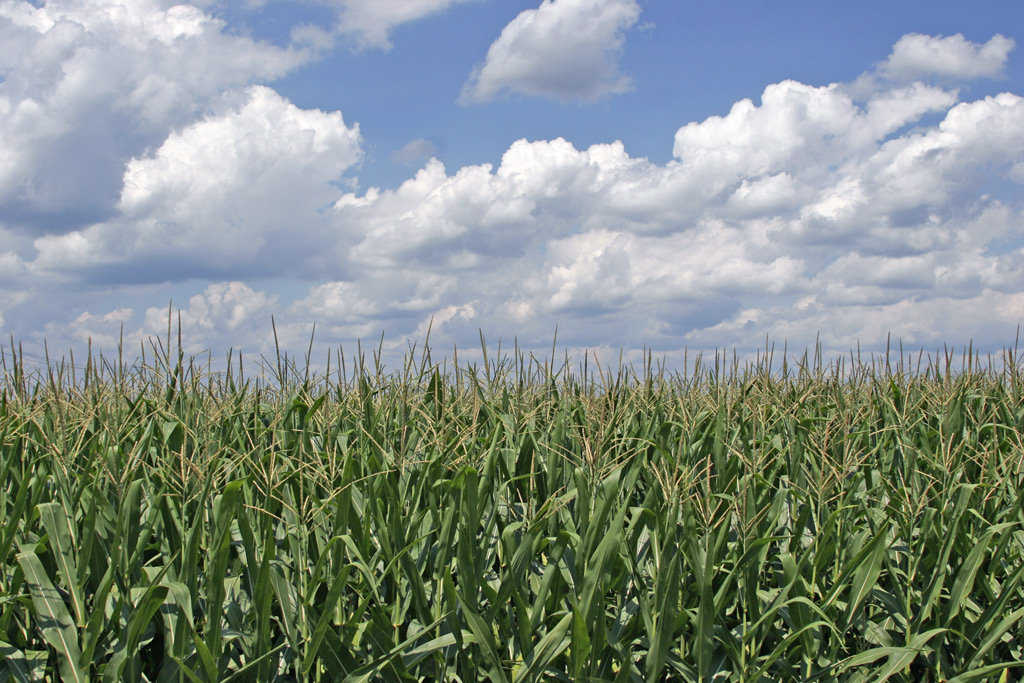
The idea of trying to grow one variety of one plant across a huge area is pretty new. We used to have a lot more variability in what we planted.
Credit: Wikimedia Commons
The importance of diverse varieties of crops has been known for thousands of years. At an anthropological museum in Cairo, in the
tomb of King Tut, there was a small partitioned box holding more than 25 varieties of barley seed, each in its own compartment. The reason assumed for this being included among the other treasures in the tomb is that they didn't know what the soil would be like in the afterlife, so a variety of seeds was included for the King's passage into the afterlife. Unfortunately, we have been forgetting this importance recently and begun focussing on super crops that will outperform traditional crops.
In order to maximize yields, founders of the
Green Revolution chose a few high-yield crops that would grow predictably and could be easily planted and harvested mechanically. With irrigation, mechanization, fertilizers, and pesticides, farmers in developed nations could maintain control over the growing process. This greatly increased yields under these highly controlled conditions, but in the process forced out a number of natural species and increased the vulnerability of the crops. There has been a push back recently from traditional small-scale farmers who try to maintain and grow a wide variety of crops and seeds
in order to survive unknown and changing soil, weather, and pest conditions. In order to help these efforts and to preserve species that would not otherwise be planted, seed banks have popped up all over the world. Below are some statistics that indicate the trend these farmers are trying to reverse:
- Of the nearly 8,000 varieties of apple that grew in the US about 100 years ago, more than 95% no longer exist. In Mexico, only 20% of the corn types recorded in 1930 can now be found.
- Only 10% of the 10,000 wheat varieties grown in China in 1949 remain in use.
- India farmers have over the last 50 years used 30,000 varieties of rice, each adapted to their local environments. It is estimated that in 2005, 75% of the rice planted in India will be one of 10 varieties.
- Nine varieties of wheat occupy half the US wheatland. 71% of the US corn crop is one of only six varieties, despite the problem that happened only a few decades ago with Texas male sterile corn.
- In the US in 1903, there were 408 edible pea varieties catalogued. Only 25 of those varieties still exist in any form, and 96% of the commercial pea crop is from 2 varieties. It is estimated that 90% of the varieties that existed in the US 100 years ago are gone forever, not being grown or stored in seed banks.
Even more: News and
the FAQ International Herald Tribune - Crop DiversityArticle on the loss of plant diversity
Click now to view Oregon State University - Crop DiversityReport on how the green revolution has created a loss of crop diversity
Click now to view International Herald Tribune - Crop DiversityArticle on the loss of plant diversity
Click now to view International Herald Tribune - Crop DiversityArticle on the loss of plant diversity
Click now to view Oregon State University - Crop DiversityReport on how the green revolution has created a loss of crop diversity
Click now to view Oregon State University - Crop DiversityReport on how the green revolution has created a loss of crop diversity
Click now to view Oregon State University - Crop DiversityReport on how the green revolution has created a loss of crop diversity
Click now to view

 Get the Facts
 Do Your Part
 Transportation
 Making Energy
 Using Energy
 Basic Needs
 Nature
 Climate Change


 Support SixLinks