How we get there
There are a number of steps that will need to be taken to ensure food security for all those in the world. This is not meant to be a definitive guide to all that needs to be done, as there are many issues that are beyond the scope of this website, but the issues discussed here are very important contributing factors to getting a greater proportion of the population access to food.
Imagine a card catalog filled with seed packets
One of the biggest issues that we've talked about throughout this section is getting more
Microfinance available throughout the world. The other main basic needs area,
Clean Water, is also important to growing healthy, successful crops. Even though the water does not need to be quite as clean as that used for drinking, there are many similar principles between getting good water for drinking and getting good water for crops.
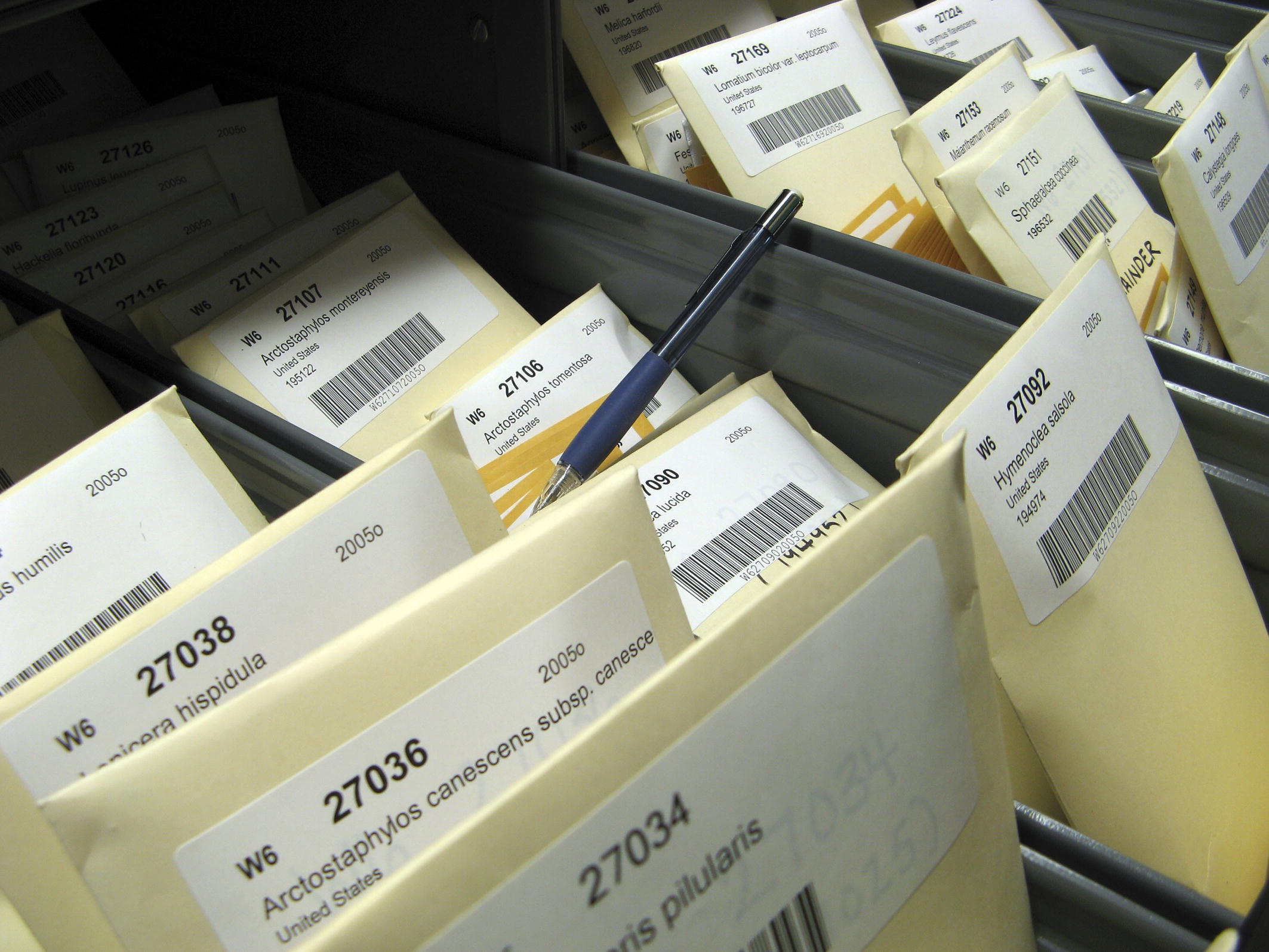
Packages of seeds of native North American plants. These are stored in a climate controlled room. These are part of a collection of 4,500 species held by the Western Regional Plant Introduction Station.
Credit: Wikimedia Commons
Another major area of focus needs to be on getting good soil that is full of nutrients, free from toxins, stable, and that doesn't require destroying natural spaces to acquire. This touches on issues of
Protecting Natural Spaces to prevent the destruction of important spaces for food growth,
Repairing Damage to natural spaces to clean up soil toxins, and
Protecting Plants to improve soil quality.
Another issue that is mentioned in protecting plants that deserves more focus here is having a wide variety of potential plants to grow. This variety of plants is something often referred to as genetic diversity. It is the result of planting a lot of different crops and allowing them to interbreed as well as allowing wild varieties of these crops to continue to evolve under different conditions. Unfortunately, we have recently begun to focus on planting only a few varieties of a particular crop, which are going to all fail or succeed together, as opposed to hedging our bets against extreme weather or disease.
This is where seed banks come into play. Seed banks are very much what they sound like. They are a place to store a large number of seeds in order to maintain the genetic diversity found within a wide number of varieties of each species of plant grown for agricultural production. Imagine a card catalog filled with seed packets, with each packet containing a slightly different variety of the same crop. Crops have evolved into different varieties over the years of different conditions in specific locations. This variety is a big part of growing crops that are appropriate and finely tuned to a particular area's soil and climactic conditions. Examples of seeds in gene banks are the dream of some breeders, such as corn that matures in 60 days and beans that thrive at
112 degrees on 9 inches of rain a year. These are things that have occurred naturally, but are being replaced by supposedly superior crops that are all the same type. You can read more in the
Where We've Been section about the recent decreases in crop diversity and the problems it's caused.
AZCentral.com - Seed BanksArticle about how the genetic diversity in seed vaults can help deal with climate change
Click now to view
 Tomo Says:
Did SixLinks make your life any easier? Return the favor by becoming a
supporting member!

 Get the Facts
 Do Your Part
 Transportation
 Making Energy
 Using Energy
 Basic Needs
 Nature
 Climate Change


 Support SixLinks