Why it's important
Sometimes, things just don't fit in an electric car. While electricity is the way of the future for the light vehicle fleet, and we must try to get as many people into hybrids and electric vehicles as possible, it is unlikely that you will see electric 18-wheelers driving by anytime in the near future. The heavy vehicle fleet relies on diesel fuel, which can be replaced by biodiesel for greenhouse gas reductions.
It is unlikely that you will see electric 18-wheelers driving by anytime in the near future
Everybody needs a friend with a big pickup truck. And, odds are, it's not going to be an electric one. These vehicles and the heavy vehicle fleet are probably going to continue running on diesel fuel (although there are some
electric heavy duty trucks out there). The environmentally favorable alternative to this can be biodiesel. While there are some disadvantages, and not all ways of making biodiesel are necessarily good, it is a rapidly growing industry that can at least replace some of our petroleum diesel consumption in the near future.
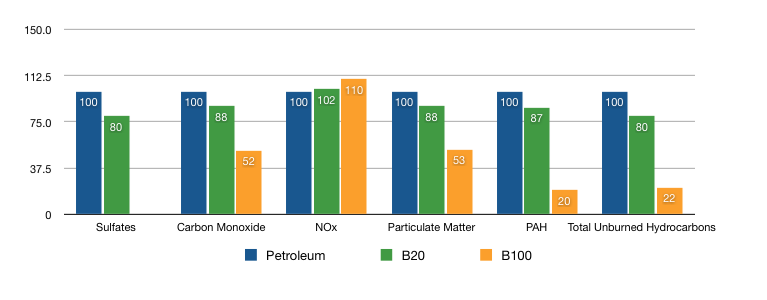
Biodiesel can reduce emissions of a lot of different pollutants. Here we compare B20 and B100 blends to petroleum diesel (all values relative to petroleum diesel set at 100%).
Credit: How Stuff WorksAdvantages
Biodiesel has an excellent energy balance,
containing 3.2 times the amount of energy it takes to produce it. This makes biodiesel a good alternative to petroleum diesel fuel if we are going to assume that electricity is not going to be a feasible near-term replacement for all the vehicles that currently run on diesel fuel. Some other
advantages of biodiesel are described below:
Locally Produced
Biodiesel can be produced from a wide variety of plant and animal products, allowing each nation to tailor fit its biodiesel production to its unique naturally resources. This could reduce the demand for imported fossil fuels in the future.
Usable in Most Diesel Engines
Most diesel engines produced after 1992 can handle biodiesel with little or no alteration. Biodiesel actually can help
increase engine life by increasing fuel lubricating properties by as much as 65% with only a 1% blend of biodiesel and by not leaving any deposits of its own. Biodiesel acts as a solvent, which helps to loosen deposits left there from petroleum diesel usage.
Less Pollutants
As you can see from the graph to the right, biodiesel causes reductions in a
number of pollutants, including unburned hydrocarbons, carbon monoxide, sulfates, polycyclic aromatic hydrocarbons, nitrated polycyclic aromatic hydrocarbons, and particulate matter. In addition, there are reductions in greenhouse gas emissions, with CO2 being reduced about
78% in B100 and
15% in B20 (depending on the fuel source). Biodiesel is the only biofuel to have successfully
completed testing in accordance with the Clean Air Act. Although biodiesel does slightly increase nitrous oxide emissions, which lead to smog production, it decreases the
unburned hydrocarbons emitted, which also contribute to smog production. Taken together, biodiesel reduces ozone forming potential of diesel fuel by nearly 50% compared to petroleum diesel fuel.
Biodegradable
If spilled, biodiesel will naturally degrade at a rate
four times faster than petroleum diesel.
Non-toxic
If spilled, biodiesel will not have any major toxic effects.
Safer to Handle
Biodiesel has a much
higher flashpoint than petroleum diesel, higher than 150°C compared to about 52°C for petroleum diesel. This means that it is less likely to catch fire when being stored or transported.
Green Car Congress - Electric Heavy Duty VehicleArticle about an electric Freightliner vehicle.
Click now to view DOE - BiodieselDOE EERE Alternative Fuels and Advanced Vehicles information on biodiesel
Click now to view Fueleconomy.gov - BiodieselGovernment website on pros and cons of biodiesel
Click now to view National Biodiesel BoardTrade association representing the biodiesel industry.
Click now to view DOE - BiodieselDOE EERE Alternative Fuels and Advanced Vehicles information on biodiesel
Click now to view National Biodiesel BoardTrade association representing the biodiesel industry.
Click now to view

 Get the Facts
 Do Your Part
 Transportation
 Making Energy
 Using Energy
 Basic Needs
 Nature
 Climate Change


 Support SixLinks